Thursday, March 19, 2020

Ten Collabs for "Asemous Font Too" by John M. Bennett & Jim Leftwich


By John M. Bennett & Jim Leftwich


By John M. Bennett & Jim Leftwich


By John M. Bennett & Jim Leftwich


By John M. Bennett & Jim Leftwich


By John M. Bennett & Jim Leftwich


By John M. Bennett & Jim Leftwich


By John M. Bennett & Jim Leftwich


By John M. Bennett & Jim Leftwich


By John M. Bennett & Jim Leftwich


By John M. Bennett & Jim Leftwich


Wednesday, March 18, 2020

Asemic Front 2 Collabs: Julie VanBortel Matevish & De Villo Sloan


Asemic visual poetry collaboration by Julie VanBortel Matevish 
(Rochester, NY, USA) & De Villo Sloan (Auburn, NY, USA)


By Julie VanBortel Matevish & De Villo Sloan


By Julie VanBortel Matevish & De Villo Sloan


By Julie VanBortel Matevish & De Villo Sloan


By Julie VanBortel Matevish & De Villo Sloan


Sunday, March 15, 2020

AF2 Review: Rebecca Resinski's Concrete Gothic Castle


Artist's book by Rebecca Resinski (published by Cukoo Grey, Arkansas, USA)


In a previous Asemic Front 2 review (June 29, 2019), I wrote about reading work by Jay Snodgrass as "asemic gothic." I proposed Snodgrass had effectively synthesized elements of medieval gothic art (calligraphy in particular) with the post-avant conceptualism of asemic writing and visual poetry. Now, I am pleased to share another work - this time by AF2 contributor Rebecca Resinski -  that blends contemporary visual poetry with the gothic literary mode (a later strain than Jay Snodgrass's sources but still part of a great gothic tree growing through time and culture).

Rebecca Resinski's Gothic: A Room With Three Windows is another elegantly produced and appropriately minimal artist's book (a total of 10 panels) by Cuckoo Grey editions. Resinski is a visual poet working in the concrete poetry tradition (or "pattern poetry" as Dick Higgins preferred to call it). Her approach is still language-centered even though forms are largely determined by geometry and, by extension, the physical  constraints of the book. 

Resinski is one of a number of contemporary poets at places around the globe who are basing their work in concrete poetry but also contributing to its evolution. Thus we can apply terms such "neo-concrete" and "new concrete" to their compositions in an era when some visual poets have abandoned text completely in favor of image sequences and associations. A concrete poetry revival is an interesting trend to note. I believe Gothic is a very interesting, even important, addition to contemporary concrete poetry.


Gothic: A Room With Three Windows by Rebecca Resinski


The content of Gothic deserves special attention. Resinski employs the post-avant method of "appropriated" text. Further, the source material is parsed (or "cut-up" as William S. Burroughs called it) and re-combined into new structures with new possibilities for meaning.

Her source text is Ann Radcliffe's novel The Mysteries of Udolpho (1794). Unlike much current writing by appropriation that focuses on public and/or media discourse, internet language and literary works connected to the post-avant, Resinski chooses an 18th century literary text by a woman. (Most avant and post-avant art is ahistorical. After several generations this mode can become problematic in terms of the societal function of culture: In other words, a permanent culture of protest denies artists the very mechanisms needed to achieve a healthy cultural evolution.) Gothic offers an alternative to the post-avant dilemma and a new possibility for cultural continuity in a post-literate society.

The Mysteries of Udolpho was popular in its time but was maligned by critics (as was most gothic fiction). Today the narrative has been elevated in literary history and is regarded as a key text in gothic fiction aka Dark Romanticism. Gothic fiction has made huge and ongoing contributions to popular culture. Resinski's close examination of gothic fiction through text appropriation and the formal qualities of concrete poetry brings the reader/viewer insights into the literary gothic as well as the emotional experience of the gothic mode; after all, the gothic is said to be a literature of "feeling" over "reason."


- De Villo Sloan


By Rebecca Resinski


Tuesday, March 10, 2020

New Asemic Visual Poetry by Eduardo Cardoso

Asemic visual poetry by Eduardo Cardoso (Sines, Portugal)


Eduardo Cardoso is a past contributor to Asemic Front as well as many other visual poetry projects in the Eternal Network and beyond. I am thrilled to be able to share this new work on AF2. 

These two pieces are excellent examples of Eduardo Cardoso's deconstructive asemics and his material-based visual poetry. The second piece that uses wooden sticks (matches?) is particularly interesting put in haptic and conceptual contexts. From an asemic standpoint, they remind me of constructs made of wood by John M. Bennett (Ohio, USA). 

Deepest thanks to Eduardo Cardoso for his continuing contributions to Asemic Front.

- De Villo Sloan


By Eduardo Cardoso


By Eduardo Cardoso


By Eduardo Cardoso


By Eduardo Cardoso


Saturday, March 7, 2020

"image degrades in proportion to hypnotic" by Borderline Grafix & De Villo Sloan


"image degrades in proportion to hypnotic" (#1) - asemic vispo collaboration 
by Borderline Grafix (Texas, USA) & De Villo Sloan (New York, USA)


"image degrades in proportion to hypnotic" (#2) - asemic vispo collaboration 
by Borderline Grafix (Texas, USA) & De Villo Sloan (New York, USA)


"image degrades in proportion to hypnotic" (#3) - asemic vispo collaboration 
by Borderline Grafix (Texas, USA) & De Villo Sloan (New York, USA)


Wednesday, March 4, 2020

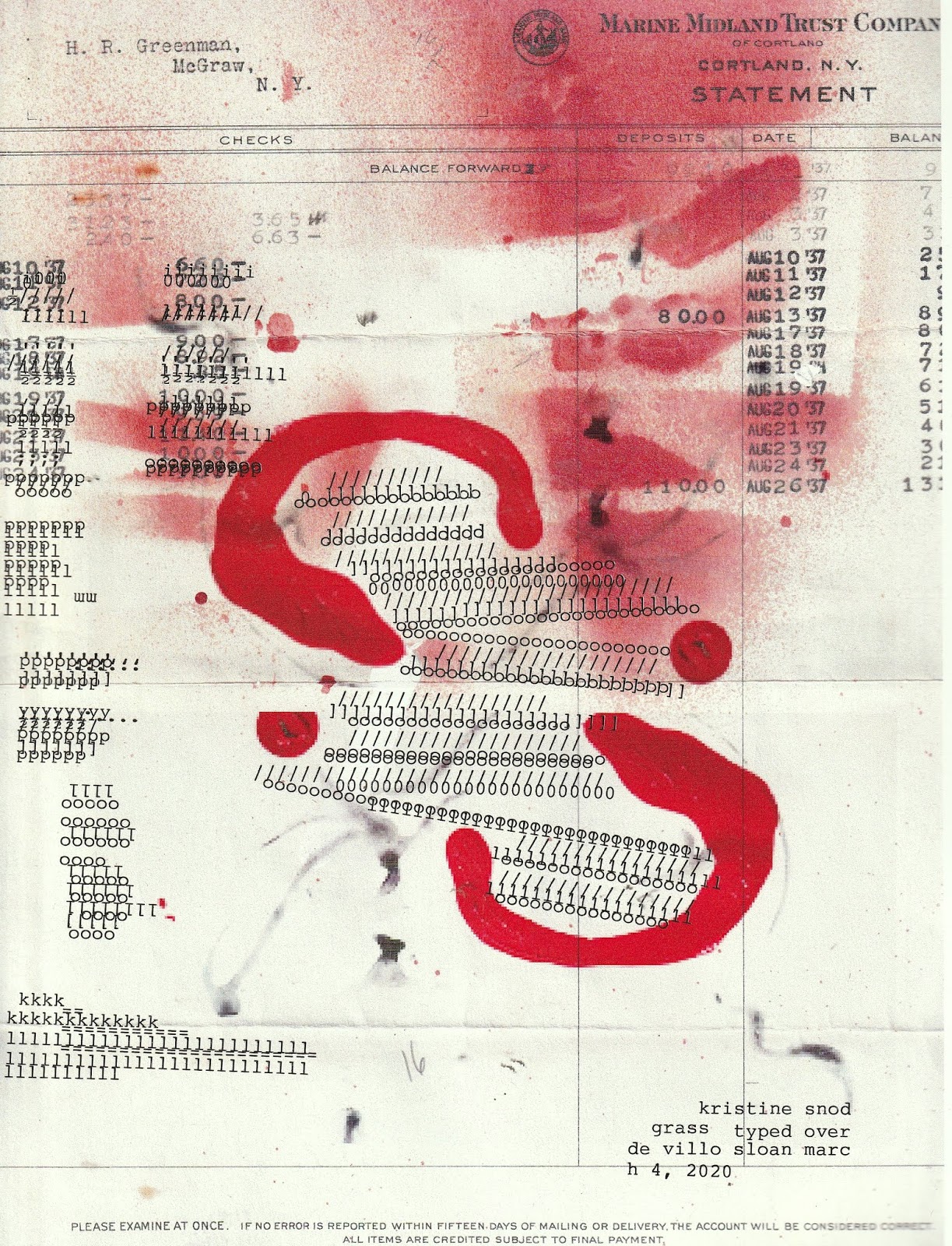
"Kristine Snodgrass Typed-over" : Asemic Visual Poetry Collabs w/ De Villo Sloan


Asemic visual poetry collaboration by Kristine Snodgrass 
(Florida, USA) & De Villo Sloan (New York, USA)


These type-overs are based on a remarkable solo series by Kristine Snodgrass recently published in Brave New World. I found the series, essentially in my view a collection of asemic glyphs, to evoke mystery and a cryptic tone. I also believe her series penetrates into deep recesses of the unconscious and shows possibilities of asemic writing so far barely realized as the field opens. See the solo pieces:

https://bnw-mag.blogspot.com/2020/03/kristine-snodgrass-six-asemic-pieces.html

I saw in these works a rare opportunity to apply my "type-overs" derived from concrete poetry in, hopefully, an interesting way. As much as Kristine's pieces are organic and sub-conscious, the concrete overlays are material language and rooted in the geometry of "pattern poetry." 

As I worked on the pieces a thought was running through my mind (and based on a discussion with Kristine Snodgrass): "Narrative is a process of overlays, omissions and obscuration." I am not even sure what that means. So I will leave the rest to kind AF2 viewers. 

- De Villo Sloan


by Kristine Snodgrass & De Villo Sloan


by Kristine Snodgrass & De Villo Sloan


by Kristine Snodgrass & De Villo Sloan


by Kristine Snodgrass & De Villo Sloan


Tuesday, March 3, 2020

Three Asemic Visual Poems by Borderline Grafix


Asemic vispo by Borderline Grafix (Austin, Texas, USA)


Borderline Grafix is an esteemed veteran of the Eternal Network. He has participated in many projects rooted in visual poetry, Fluxus, conceptualism and collaboration. I am very pleased that he is now part of Asemic Front 2.

Borderline Grafix is a gifted collage solo artist. As these AF2 pieces reveal, his vispo and asemic compositions are rooted in collage. He sent these works via the Asemic Writing for Mail Artists group at IUOMA-Ning. This group provides a steady stream of excellent work for the Asemic Front project. I believe an examination of the group's history will reveal that the type of asemic-vispo hybrid work prevalent in the Eternal Network today has its roots in that group of artists and poets who have shared their work with each other for years.

Thanks to Borderline Grafix!

-De Villo Sloan


By Borderline Grafix


By Borderline Grafix