Showing posts with label visual. poetry collab. Show all posts

Wednesday, July 31, 2024

AF2 Commentary: Introduction to Asemics 16 Edition #2 (revised) by De Villo Sloan


Visual poetry collab by John M. Bennett (Ohio, USA) 
& De Villo Sloan (NY, USA)
Asemic Front Archive


                         Asemics 16 Collaborative Mail-Art Book Project


                                              Introduction to Edition #2


                                                       By De Villo Sloan


In this second edition of the Asemics 16 mail-art project, you will find remarkable work by artists from around the world who have shared their talents and ideas to explore and expand the esoteric and fascinating practice of asemic writing.

We were very fortunate to benefit from the involvement of highly regarded artists and writers who work on the borderland where text and image meld. I offer special thanks to John M. Bennett and Cecil Touchon.

Asemics 16 is made even more unique because it also attracted artists producing highly innovative work in areas including painting, collage, photography and conceptual art. They brought tremendous excitement and enthusiasm. Their work opens vast possibilities for the future as we enter an era where traditional notions of poetry, fiction, and the text are reframed around the concept of post-literature.

The realm of asemic writing includes the invention of de-semanticized texts with corresponding symbols and systems for their arrangement. Asemic writing might at times reveal traces of known language but ultimately cannot be read as any existing language or extinct language that has been recorded.

The Asemics 16 book project was launched in May 2011 by South African artist Cheryl Penn. As the result of her study of U.S. artist Ray Johnson, Penn has led a number of highly successful book projects through the global mail-art network. The International Union of Mail-Artists (IUOMA), founded by Ruud Janssen of the Netherlands, served as an ideal headquarters in cyberspace for an effort that required extensive coordination and communication.

One beneficial aspect of the project made possible through IUOMA was group discussions that preceded individual work on chapters (and later sharing drafts). These included forming a consensus definition of asemic writing where participants explored topics including the relationship of found and natural objects to asemic writing; the relationship of asemic writing to visual poetry and concrete poetry as well as haptic and object poetry; and applications of cultural theory to illuminate practice. Examples of work by earlier authors and artists were discussed, in particular Cy Twombly, Mirtha Dermisache, Henri Michaux, and the collaborative work of Brion Gysin and William S. Burroughs.

This second edition is rich in approaches to creating asemic writing. You will see beautiful and highly expressive cursive script where letters, words and phrases emerge, mirage-like – hinting at a message to the reader – only to fade elusively back into incomprehension and fragmented shapes that rise and fall from the unconscious.

Other artists take a material approach, fragmenting the existing letters into new symbols and syntax. Many of the artists have focused on placing their asemic work in relationship with other images, often creating a narrative context and inventing various hybrid visual-textual forms.

In the pages ahead is a dialog about the nature of language and the human experience by artists from an incredible array of cultures and perspectives. I invite you to delve deeply and enjoy their tremendous contributions.


De Villo Sloan

August 10, 2011

Auburn, New York

(revised 7.30.2024)


Friday, January 21, 2022

Add & Pass Vispo Mail Art Boekies by Jean Paul Podevin - Would You Like to Participate?


Mail art by Jean Paul Podevin (Les Mureaux, France)


Mail art by Jean Paul Podevin


Jean Paul Podevin was not, until today, one of the visual poet-mail artists who regularly contributes to AF2. New friends are always welcome & Jean Paul sent add & pass books ready for circulation upon documentation.

Jean Paul has included enough image-text for me to focus these on asemics & vispo. I have two books. Contact me if you would like one of these mailed to you. You can collab with Jean Paul & me. Then pass the book along to another asemic writer or visual poet. Maybe they will come back.

Otherwise, I hope you enjoy the images. 

- De Villo Sloan


Collab by Jean Paul Podevin & De Villo Sloan 
(January 20, 2022)


Collab by Jean Paul Podevin & De Villo Sloan 
(January 20, 2022)


The mysteries of mail art: The contemporary zinester 
Bonnie Diva (Illinois, USA) has already contributed to one book.


Friday, December 17, 2021

AF2 Lost Classic: Asemic/Pansemic by Todd Burst - An Essay


Asemic writing - visual poetry by Nancy Bell Scott (AF2 Archives)


Asemic/Pansemic?

By Todd Burst

First published July 14, 2018:

https://jburst88j.medium.com/asemic-pansemic-bff57a0dcfc4

Asemic writing is a wordless open semantic form of writing.[1][2][3] The word asemic means “having no specific semantic content,” or “without the smallest unit of meaning.”[4] (from Wikipedia)

In 2015 (Scriptjr.nl), artist Jim Leftwich argued that “there’s no actually perfect ‘asemic’ thing or sign, since everything conveys some meaning, everything may find its way to - at - least an inner ‘emotional’ (scribble of) meaning.”

So, instead of using the term asemic to denote a - rather new - art form, Leftwich proposes that we use “pansemic.” Pansemic means, “that everything emits/ expresses some semantically rich sign, always provided with almost a shadow of meaning; so everything makes sense and a bunch of meaningful directions may always be attached to the invisible arrows uprising from any of the written traces we imagine and conceive and make or find.”


Asemic visual poetry by Kerri Pullo (AF2 Archives)

Unfortunately, I disagree with this. Although I respect and very much enjoy Leftwich’s work, I think his concept of asemic/ pansemic might need more reflection. But before I begin my tirade, I want to make it known that I am a philosopher and a follower of Ludwig Wittgenstein: That is to say, I believe meaning is contextual, social and part of our everyday normal routines of doing things, i.e. language is a behavior, etc.

The problem I have with Leftwich’s comment - “that everything emits/ expresses some semantically rich sign” - borrows from structuralism/ postructuralism and Wittgenstein. The meaning of a word (for a structuralist and/or postructuralist) emerges through its difference with other words.

To say that everything is meaningful negates non-meaningful, which in turn negates meaningful since we can’t determine the difference between a meaningful and non-meaningful “semantically rich sign.” So, to say everything has meaning is to say nothing has meaning, but this does not get us back to asemic writing.

Secondly, meaning - in semantics, language, etc. - is socially understood… socially communicable. So a pansemic work would have to elicit a linguistic response - not a feeling - that we would all understand or could be made to understand via language.

________________________________________________

"Abstract art and asemic writing can convey a feeling or an aesthetic quality that remains unnamable, but that does not mean that it is endowed with meaning. A sensation and meaning are two different things. This does not mean that we will not find a common way of speaking about a common aesthetic it-ness that a certain asemic work elicits. This could happen, but it has not."  - Todd Burst

_________________

Abstract art and asemic writing can convey a feeling or an aesthetic quality that remains unnamable, but that does not mean that it is endowed with meaning. A sensation and meaning are two different things. This does not mean that we will not find a common way of speaking about a common aesthetic it-ness that a certain asemic work elicits. This could happen, but it has not.

I agree with most of Marco Giovenale's response to Leftwich:

"A 'proper' [sic] asemic area can be seen in the zone of the mind opaquely linking our expectations for a known written linguistic message and content to an actually unknown shape of glyph.... a whole text or drawing appears in front of us an asemic 'thing,' indecipherable to the intellect that does not recognize the language; but at the same time it may be meaningful to the taste... perception,,, soliciting empathy... sensations.... or something similar."

I generally agree with Giovenale's writing. In the Present case, I believe he explains how any glyph, symbol, etc. could represent this "sensation[s],"but we do not have "access" to this particular symbol.

I disagree with the definition and application of "pansemic" for reasons stated above. I think "asemic work" is much more suitable for the art both Leftwich and Giovenale create, because it makes a tension between what can be expressed and what cannot.

Meaningless writing is beautiful because it does not weigh us down with tangibility, Asemic writing should stay true to its asemia (?!?) its (non-sense).

                                                                                -sSs-


Asemic visual poetry by Todd Burst (2021)

Editor's Note: Todd Burst aka Toddy Bee lives in New Orleans, Louisiana, USA, and studied at the University of New Orleans. He is an Asemic Front 2 contributor.


Thursday, September 3, 2020

Tuesday, June 30, 2020

Asemic collabs by Laura Ortiz & Peter Ganick


Asemic-vispo collaboration by Laura Ortiz (Toronto, Canada, USA)
 & Peter Ganick (West Hartford, Connecticut, USA) (1946-2020)


I am thrilled to be able to share two spectacular collaborations by Laura Ortiz and avant/postavant artist, poet & composer Peter Ganick, who sadly passed away this year. Laura Ortiz is well-known in the visual poetry & asemic writing communities; she has been a faithful contributor to the Asemic Front project. Deepest thanks to Laura.

Laura Ortiz has spoken of Peter Ganick as a favored collaborator & mentor. These calligraphic pieces indicate why she has enjoyed working with him. I am deeply saddened we have lost him but know his work will continue to enlighten us.

- De Villo Sloan


By Laura Ortiz & Peter Ganick


Monday, June 22, 2020

"Whistle" by Kristine Snodgrass & De Villo Sloan published in the Asemic Front Series

Collab by Kristine Snodgrass & De Villo Sloan


June 22, 2020 -- The Asemic Front project is thrilled to announce the publication of Whistle, a collaborative book of visual poetry, asemic writing and collage by Kristine Snodgrass and De Villo Sloan. This is the first full-length book published in the Asemic Front Series.

Whistle includes over 50 large-format, full-color compositions and in-depth essays on the process by both Snodgrass and Sloan. The book is available through Amazon.

Whistle is the result of an extended collaboration between Snodgrass and Sloan conducted during March and April of 2020. Snodgrass (in Florida) and Sloan (in New York State) exchanged drafts both digitally and via snail mail during the challenging and uncertain weeks of the pandemic lockdown in the USA. 

Whistle will doubtless be viewed in the context of the global creative outpouring that occurred during the 2020 pandemic. However, Whistle readers will also discover a thoughtful dialogue in images and text about gender, sexuality, violence and power.

“We discussed our conscious modalities of gender at work,” said Kristine Snodgrass. “We agreed there was something to be worked out. This led me to tour the pieces we did with a closer eye: for signs of power, gender dynamics, sexuality. I think all of this remains unresolved. But that is the place where we invite readers to join in the process.”

De Villo Sloan explains, “I engaged in Whistle at a time when I was making a lot of concrete poetry with an old, electric typewriter. I typed over work by mail art friends with thick layers of type then returned it to them and posted the results online.

“I charged into the Kristine collabs with type-over fervor; but as soon as I began my usual process, I had an intuitive pang that this was a wrong approach and that with no prompting from Kristine. Thus, you will see my type-overs in Whistle; and you will also see the type-overs evolve into forms that allow for dialog.”

Poet Michael Rothenberg writes about Whistle: “Cats, fish, faces, roosters, and orchids make a sudden appearance in the asemic veil, and then return to fatal abstraction and illumination. Whistle is the vehicle, instrument, lip, lung and death rattle exhale, where collaboration becomes one emanation.”

Kristine Snodgrass is a poet, curator, Co-Director of Anhinga Press and Associate Professor at Florida A&M University. She has published books, chapbooks and her writing has appeared in numerous literary journals. Kristine has participated in successful poetry collaboration projects, including work with her mentor Maureen Seaton. Recently, she has applied her considerable talents to the postavant areas of visual poetry and asemic writing.

De Villo Sloan currently focuses his energy on concrete poetry, asemic writing and writing reviews and theory in these areas. He earned a Ph.D. in English from the State University of New York at Buffalo where he studied with Robert Creeley. His writing has appeared in numerous literary journals. Last year the second installment of his “Neo-Concrete Series” was published as issue #71 of Miekal And’s Xerolage.

Asemic Front is an ongoing project, rooted in the international mail art community, that encourages the creation and sharing of asemic writing, visual poetry, concrete poetry and – especially – collaboration in these genres. 


Wednesday, March 4, 2020

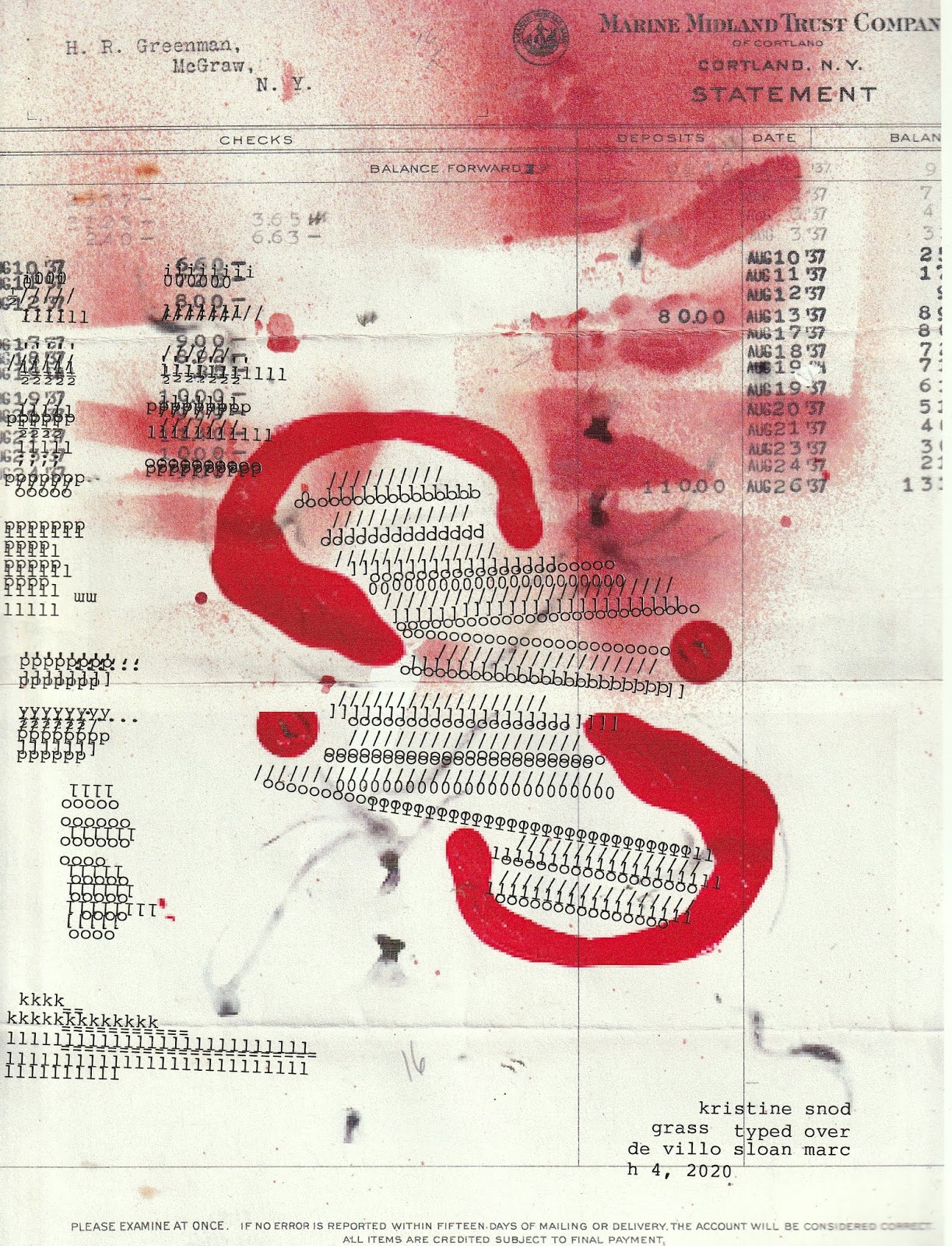
"Kristine Snodgrass Typed-over" : Asemic Visual Poetry Collabs w/ De Villo Sloan


Asemic visual poetry collaboration by Kristine Snodgrass 
(Florida, USA) & De Villo Sloan (New York, USA)


These type-overs are based on a remarkable solo series by Kristine Snodgrass recently published in Brave New World. I found the series, essentially in my view a collection of asemic glyphs, to evoke mystery and a cryptic tone. I also believe her series penetrates into deep recesses of the unconscious and shows possibilities of asemic writing so far barely realized as the field opens. See the solo pieces:

https://bnw-mag.blogspot.com/2020/03/kristine-snodgrass-six-asemic-pieces.html

I saw in these works a rare opportunity to apply my "type-overs" derived from concrete poetry in, hopefully, an interesting way. As much as Kristine's pieces are organic and sub-conscious, the concrete overlays are material language and rooted in the geometry of "pattern poetry." 

As I worked on the pieces a thought was running through my mind (and based on a discussion with Kristine Snodgrass): "Narrative is a process of overlays, omissions and obscuration." I am not even sure what that means. So I will leave the rest to kind AF2 viewers. 

- De Villo Sloan


by Kristine Snodgrass & De Villo Sloan


by Kristine Snodgrass & De Villo Sloan


by Kristine Snodgrass & De Villo Sloan


by Kristine Snodgrass & De Villo Sloan


Monday, January 13, 2020

Asemic Front Review: "palingEnesia" by Michael Orr (Timglaset Editions - Sweden)

 
Cover of palingEnesia by Michael Orr (aka Orzechowski). Published
in 2019 by Joakim Norling's Timglaset Editions (Sweden)
 
 
Asemic Front 2 is thrilled to share news of the publication of Michael Orr's palingEnesia by Timglaset Editions in Sweden.
 
Michael Orr is a contributor to the Asemic Front project, and I look forward to sharing more of his work in the future. In the spirit of full disclosure, I must note that I wrote the introduction to palingEnesia. So you can find my theoretical views on Orr's visual poems in the book; obviously I am a longtime Orrian or in other words a huge Michael Orr fan.
 
I will try not to use this space to recycle my essay or meta-criticism. I am compelled to tell you that I see palingEnesia as a significant book in the genre of visual poetry and in Michael Orr's evolution as an artist and visual poet.
 
In an age of look-a-likes, copycats and knackers ("You're living off the corpse of the old world, Max."), Orr introduces us to his highly original vispo and asemics that achieve the elusive synthesis of text and image, a feat often promised by visual poets but seldom delivered. For me, palingEnesia marks a breakthrough for Orr from a skilled (as well as conceptual) visual artist into a true visual poet who has discovered a new world of symbols and forms. The excitement of the discovery is a factor that gives the collection energy.


Pages from palingEnesia by Michael Orr (Timglaset Editions, Sweden)


I am sure that many readers know the feeling - akin to struggling in quicksand - of trying to explain rationally in words the subjective experience of entering an asemic text or visual poem. (Have we evolved to visual poetry precisely because previous modes of poetry are no longer adequate?)

I was humbled and enlightened, then, upon receiving my copy of Orr's book with commentary by Bibiana Padilla Maltos. In a few words she offers clear insights into Orr's work that eluded me in paragraphs. I share these words by Bibiana: "Michael Orr's paling Enesia balances visuals and textuality in an array of exceptional concrete imagery. He creates a semiotic study that helps us scrutinize our personalities and cognition."


From palingEnesia by Michael Orr (Timglaset Editions, Sweden)
 
 
Joakim Norling's Timglaset Editions is becoming, if it has not already achieved the status of, a world leader in visual poetry, asemic writing and concrete poetry publishing. palingEnesia is beautifully printed and the color, especially, is remarkable. All in all, this is a superb book that offers hours of contemplation and joy.
 
- De Villo Sloan


Thursday, November 28, 2019

Selections from a collaborative book by Laura Ortiz & De Villo Sloan

 
Cover of UNO by Laura Ortiz (Toronto, Ontario, Canada)
& De Villo Sloan (Auburn, New York, USA) (Oct.-Nov. 2019)


As part of our recent Asemic Front 2 collabs (October-November 2019), Laura Ortiz assembled a series of our thematically connected pieces into an artist's book. I have titled it UNO due to the frequency of the letters U-N-O in the text as well as the appearance of the word "one." I also believe "uno" represents what I perceive to be the seamless quality achieved in these compositions where our styles and thematic concerns are blended perfectly. Deepest thanks to Laura Ortiz for producing this sequence.
 
- De Villo Sloan


By Laura Ortiz & De Villo Sloan


By Laura Ortiz & De Villo Sloan


By Laura Ortiz & De Villo Sloan


By Laura Ortiz & De Villo Sloan


By Laura Ortiz & De Villo Sloan


By Laura Ortiz & De Villo Sloan


By Laura Ortiz & De Villo Sloan


Back cover of UNO by Laura Ortiz & De Villo Sloan


Monday, November 25, 2019

Asemic & Visual Poetry Collabs by Laura Ortiz & De Villo Sloan (Part 1)


Asemic Front 2 collab by Laura Ortiz (Toronto, Canada) &
De Villo Sloan (Auburn, New York, USA). (November 2019)


By Laura Ortiz & De Villo Sloan (detail)


 By Laura Ortiz & De Villo Sloan


Asemic Front 2 collab by Laura Ortiz (Toronto, Canada) &
De Villo Sloan (New York, USA)


By Laura Ortiz & De Villo Sloan


By Laura Ortiz & De Villo Sloan


By Laura Ortiz & De Villo Sloan


By Laura Ortiz & De Villo Sloan


 By Laura Ortiz & De Villo Sloan


By Laura Ortiz & De Villo Sloan


By Laura Ortiz & De Villo Sloan


By Laura Ortiz & De Villo Sloan