Asemic, Pansemic & Peirce’s Triadic Model of the Sign
By Chris Wells
1.
The thought of writing this down has been bouncing around in my head
for years. I wanted to understand why the term “asemic” does not seem accurate
to me. I never felt strongly about the issue because the “asemic” movement has
taken on a life of its own. The term does distinguish something recognizable.
I also wanted to explore why the term "pansemic" (also originating
with Jim Leftwich) resonates with me although it seems to lack widespread
acceptance.
By way of preface, I want to disclose that
I am an amateur in poetic theory. I hope my work in this essay expands my
personal mastery of concepts discussed below. Ultimately, I hope my ideas and
research provide you with new insights.
I have never formally studied
semiotics, although I am not entirely a newcomer to it, either. (In fact, the
only academic paper I ever published, in addition to a master's thesis,
appeared in The Interdisciplinary Journal for Germanic Linguistics and
Semiotic Analysis.) I would welcome friendly help in refining any of these
concepts from whomever would be so willing.
2.
Asemic writing is a popular
practice in 2022. Apparently, it emerged in multiple quarters across the globe, and
its popularity has increased sharply in recent decades. The appeal of asemics
has been widely described as “democratic.”
To be more precise, I would say the
asemic spirit is closer to “anarchism” in the best sense of that word: a fully
free and open practice and a correspondingly free, open, and decentralized
worldwide community of practitioners. No wonder there is a large intersection
that connects mail artists, visual poets and asemic writers.
But what is asemic writing? What might
the word “asemic” mean? Is it the best descriptive term? I have read several
authors on the subject, but I will not quote or paraphrase anyone else at this
stage. This is a preliminary sketch of my own ideas, especially as the result of
encountering Charles Sanders Peirce (1839-1914) as an undergraduate while writing a paper on the
Gothic translation of the Bible.
My love of historical and textual
linguistics as an undergraduate naturally led me to question why the limits of
a “text” should be bound to a sequence of words, when there are other symbols
and signs all around us. This led me to read Peirce's semiotic theory. (I also
read about his metaphysics.)
The practice of asemic writing has
fascinated me for a long time. I have explored “illegibility” from a poetic-artistic
standpoint. Generally, I have never fully embraced the word "asemic.” But
neither do I reject it. I would like to discuss what, from my own standpoint
grounded in Peirce's triadic semiotic theory, asemic writing is. I do not
reject the term “asemic” although it is (technically speaking and arguably)
inaccurate, or at least imprecise.
__________________
“Unlike semiology, structuralism and
post-structuralism, which are grounded in Ferdinand de Saussure's binary
distinction between signifier and signified, Peirce's concepts are often
triadic….”
- Chris Wells
__________________
Here is my brief explanation of
Peirce's concepts that are relevant to this discussion: Unlike semiology,
structuralism and post-structuralism, which are grounded in Ferdinand de
Saussure's binary distinction between signifier (a word, for example) and
signified (what the word refers to), Peirce's concepts are often triadic. This
was fruitful in his discussion of the process of signification and
interpretation, broadly termed semiosis (from Greek sema,
sign).
In my attempt to briefly explain
Peirce's view, I will start with the sign, or representamen. You
can imagine this as the more familiar term signifier. This
representamen signifies something, an object, which by definition
must be something different from itself.
Every sign is in some respect an
object, even if only a mental, imaginary or purely conceptual one. But a sign
is an object that somehow signifies (in one of three ways, discussed below)
another object.
____________________
"The third part of [Peirce’s] triad is,
from my perspective, the most interesting: the interpretant.
Signs involve an interpreter that becomes involved in the process, and it is
only by an interpretation that anything becomes a sign at all."
- Chris Wells
____________________
"[a] sea" by Chris Wells (Ohio, USA) (December 2021)
The third part
of the triad is, from my perspective, the most interesting: the interpretant.
Signs involve an interpreter that becomes involved in the process, and it is
only by an interpretation that anything becomes a sign at all. Otherwise, it
is simply two objects that have no particular relationship to anyone or
anything.
3.
The interpretant is a resultant
interpretation of a sign. Modern Peircean semioticians have gone so far as to
say interpretants do not need to be mental, and so there is no need for a consciousness to
be present as an interpreter. In this way, they attempt to provide a semiotic
theory of the natural world itself. (I do not know much about this area of
semiotics, but you can search “physiosemiosis” to learn more if you are
interested.)
_____________________
“The interpretant itself becomes, in
experience, a representamen for other objects, which then results in further
interpretants, in a potentially infinite chain of signification.”
- Chris Wells
_____________________
Asemic vispo by Kristine Snodgrass & De Villo Sloan (2021) (AF2 Archives)
The
interpretant itself becomes, in experience, a representamen for other objects,
which then results in further interpretants, in a potentially infinite chain of
signification.
Take an interpretation of a word as an
illustrative example: The word has as its object a concept or
definition. For example, the word “ball,” when interpreted as a word in English,
has as its interpretant the definition of “ball”: a spherical object, perhaps a
toy, etc. In the larger context in which it is uttered, it might also refer to
a basketball or a tennis ball. And it might be a particular ball in a game I am
playing with a friend, or it might be an imaginary ball in a story I am reading
or hearing someone tell. It could also be a script that I am supposed to read
aloud. In this case, the interpretant of “ball” (a written word) would become “ball”
the spoken word according to the conventions of spoken English.
You can see how the triadic theory is
cyclical, interpretants (e.g. definitions) giving rise to further interpretants
(e.g., physical objects). You can also see how interpretants can be very
straightforwardly other signs or representamens (a written word that becomes
its spoken equivalent).
In his characteristic love of triadic
thinking (I have seen the word triadomania used to describe
it), Peirce also distinguished three types of signs: the index, the icon and
the symbol. A sign is an index if it indicates something
closely related. A classic example is that smoke indicates fire.
A sign is an icon if
it shares a likeness to that which it signifies. For example, a photograph of a
fire is an icon of a fire. The relationship is so close that if you were to
show someone a photograph of a fire and asked them, "What is this?"
they would likely say “fire” - that which it represents - instead of saying “a
photograph.”
_____________
"A symbol is a sign that takes its meaning from convention. For example, language is made up of symbols. So is mathematics, at least as it is notated."
- Chris Wells
_____________
A symbol is a sign
that takes its meaning from convention. For example, language is made up of
symbols. So is mathematics, at least as it is notated.
Obviously, the lines blur here and all
build on one another. For example, if I heard a man yell, "Fire!" in a
crowded theater (to use a cliché example that continues with the theme), the
word, "Fire!" is a symbol for the "thing" we call
"fire" in English.
The loudness and perceived emotion behind the
man's exclamation may indicate urgency and danger to be avoided. The fact that
it sounded like a man's voice shows an iconic relationship to a man. But what
if it were a scene in the play itself, and I somehow misinterpreted it as an
indication of real danger? Then the iconic signification still exists; the
voice was a man's voice. However, indexically, it indicated a fictional scene
and not an urgent one. The play itself is made up of an entire network of conventions
that contributes symbolic signification in addition to iconic and indexical.
Collab by Chris Wells & De Villo Sloan (September 2017) (AF2 Archives)
4.
This has been a long introduction to
my own definitions of pansemic and asemic. Asemic implies
or suggests several things: That it is not “semic,” there is no sema involved,
that it does not participate in signification or semiosis, that it signifies
nothing.
However, to paraphrase semiotician
John Deely, everything, to some extent and in some way, becomes a sign by our
mere experience of it. How might this apply to asemic writing? First, we can
talk about what is asemic about it.
___________________
“Asemic writing is inherently devoid
of a ‘code’ of symbolic relationships. This is what distinguishes it from other
forms of writing in any language or other symbolic codes, which include
recognizable [conventionally readable] symbols...."
- Chris Wells
Writing does not have to be fully
readable in a shared, existing language to be symbolic. Writing systems correspond,
in so far as they are linguistic and not asemic, to an existing language, sign
system or code to ascribe meaning: something set in convention. Asemic
writing does not do this; this is what is intentionally excluded insofar as it
is asemic.
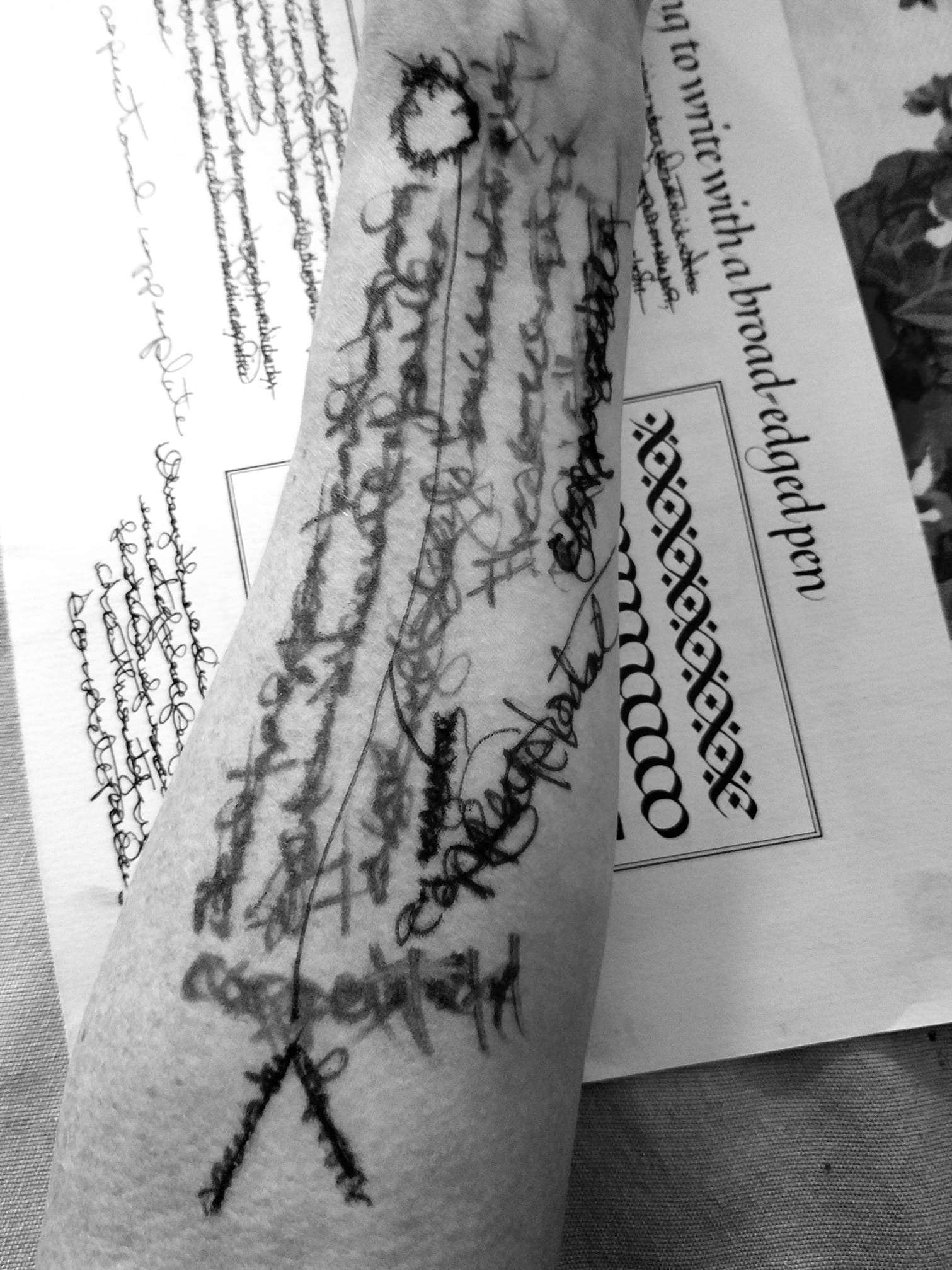
Iconically, asemic
writing is writing. One can recognize, without necessarily
understanding why, that the asemic piece intentionally mimics the visual appearance of written text,
rather than the expressive conventions of abstract painting or drawing. How does this
work?
An analogy I offer: When I was making
music, I stumbled upon a technique where I took spoken voice recordings, lowered
the voice volume significantly and applied layers of reverb. This produced what
parapsychologists call "the sense of a presence" in my mind: The
sound was similar to a human voice speaking, but it was altered enough that the
meaning was entirely undiscernible and with only a faint and indeterminate
suggestion of emotional expression.
____________________
“Asemic writing is ‘illegible’ if by
this we mean it is not decodable (i.e., it participates in no symbolic code to
carry a ‘message’ in the ordinary sense). Some asemic writers, including
myself, create a ‘damaged’ writing.”
-
Chris Wells
_____________________
Early asemics by Jim Leftwich (AF2 Archives)
In a similar
sense, asemic writing is “illegible” if by this we mean it is not decodable
(i.e., it participates in no symbolic code to carry a “message” in the ordinary
sense).
Some asemic writers,
including myself, create a “damaged” writing, just as the
human voice in processing it with reverb is “damaged.” But there is a trace or
remnant that suggests a presence: the at-one-time presence of a human being or
a consciousness that shares similarities to a human mind, in the process of
expressing itself.
All forms of asemic writing, from a child’s scrawl, to overwriting/palimpsest techniques, to overstriking with a
typewriter, to partial but indeterminate letteral marks made of stencils or by
a collage technique, intematerial - produce an incomplete or
damaged form of writing that does not belong to a pre-established symbolic
code, even if the asemic text alludes – however vaguely – to other shadow
texts.
_______________________
“All forms of
asemic writing… produce an incomplete or damaged form of writing that does not
belong to a pre-established symbolic code, even if the asemic text alludes - however
vaguely - to other shadow texts. This is largely done via what
we could call iconici, a resemblance, however faint or indeterminate, to
writing.”
- Chris Wells
_______________________
Indexically, asemic
writing is open and indeterminate. For example, visual
poet Cheryl Penn (South Africa) has explored asemics using a process similar in
composition and analysis to the famed Rorschach psychological test. Even the
simple experience of watching clouds (pareidolia) is changed
dramatically through an asemic lens.
Asemic vispo by Cheryl Penn (South Africa) (2019) (AF2 Archives)
In asemics, we can deduce little of a
writer’s intention or biography. The viewer joins the process in a
collaborative spirit. They provide vital associations from their own experiences
to provide an interpretation. Asemic reading alters conventional relations
between creation and collective interpretation.
Many have written that they believe
they perceive expressive energy or emotion in the asemic text. We may form
associations in our minds from the shape and arrangement of writing on the page.
This is similar to the way we are (culturally conditioned) to seek meaning, for
instance, in the visual syntax of abstract art.
Iconically, asemic writing invites
indexical literary associations just as much as it invites the visual-artistic.
Since it can be done at any scale, by anyone who knows how to write (which in
this case, does not imply any minimum standard of literacy), the communities
around it are naturally decentralized, open, and in my experience welcoming, as
are its associated mail art and visual poetry communities.
By subtracting the symbolic/linguistic/conventional qualities of
ordinary writing and retaining the iconicity of writing, we are left with a practice
of writing that is radically indeterminate by its very nature.
Freedom from linguistic constraints and language tradition allow asemic writing to become a genre in the 21st century that greatly
expands global inclusivity and participation. Asemic reading - a majority community
consensus is evident - is indeed, for me, more accurately defined by the word “pansemic”
than “asemic.”
-sSs-