
Asemic visual poetry by Luc Fierens (Mechelen, Belgium)

"Fantaisie" by Luc Fierens


Asemic Front 2 Review: Asemic Migration by Nico Vassilakis (Afterward by Marton Koppany). Sigilist Press. 2022. 16 pages; eight plates
Review by De Villo Sloan
Andrew Brenza, a star of the New Concrete poetry, is sharing his creative time and energy with us further through his new publishing venture: Sigilist Press. The first release, Asemic Migration, is an exploration of asemics by Nico Vassilakis with an essential afterward by Hungarian vispo luminary Marton Koppany.
As asemic theory develops coherence and recognizable sub-genres emerge, Vassilakis applies his ever-powerful perceptions to an area known as "found asemics" or (as I prefer) "eco-asemics." The book is a slim gathering of eight black and white photos showing cloudy skies with (sometimes linear) ranks of migrating birds, a contribution of note to eco-asemics.
Most of us reading Asemic Migration are surely drawn to the organic structures of flying birds inscribed upon the sky. Thus the collection is immediately accessible to a wide audience.


Marton Koppany is much-admired for his vispo theory. The inclusion of his afterward is another excellent choice for Asemic Migration. Hopefully, we are all becoming better asemic readers. For this reason, I encourage asemic writers to include statements, theory and explication in their books.
In the afterward, Koppany compares Asemic Migration to bookworks by Ed Rusha [Ruscha], such as Twentysix Gasoline Stations or Thirtyfour Parking Lots as a context for Asemic Migration.
Koppany offers other key insights as well. He writes, "Were the birds larger (or the sky smaller), we could see each and every one of them, they would not disappear behind the indecipherable letters, words and phrases created by their flight in flocks, in place. If asemic writing looks like writing but cannot be read in a strict sense, Asemic Migration describes an escape that gets you nowhere."
Vassilakis connects us to the near-universal human experiences of wonder via changings seasons and recognition of temporality. More specifically, however, he offers a relentless meditation on the primal roots of language in nature. I find the collection becomes more and more engaging with each fresh reading.
-sSs-


Many AF2 readers are aware visual poet Kristine Snodgrass is currently working with asemic tattoos and body art, generating fascinating documentation that can be found at a number of online venues. Snodgrass discussed this art extensively (along with her femsemic theory) in her recent AF2 interview. If you somehow missed it, I strongly recommend you take a look:
https://asemicfront2.blogspot.com/2022/04/asemic-front-2-interview-kristine.html
Snodgrass has recently completed asemic body art collabs with Colin J. Rae & Jay Snodgrass, among others.
As a continuation of the tatasemic narrative, I am thrilled to have obtained permission to share these collabs where Kristine Snodgrass is the foundation for the distinctive calligraphic style of New England visual poet Karla Van Vliet.
Van Vliet is also no stranger to AF2. Among other material, I was thrilled to be able to report on the success of her book She Speaks Tongues (Anhinga 2021)
https://asemicfront2.blogspot.com/2021/12/af2-meta-review-karla-van-vliet-she.html
Deepest thanks to Karla Van Vliet and Kristine Snodgrass.
- De Villo Sloan


Asemic
Front 2 Interview:
Kristine Snodgrass on the WAAVe Collective & Gender in Asemic Writing, Visual
Poetry & the Post-Avant
By De Villo Sloan
Kristine Snodgrass is a widely known and critically acclaimed visual poet and asemic writer. A much-sought-after collaborator, her recent books include Neon Galax (with Andrew Brenza, Unsolicited Press 2022) and Loom (with Collin J. Rae, Alien Buddha Press 2022). She is also the author of the asemic-vispo classics Rank (JackLeg Press 2021) and American Apparell (Alien Buddha Press 2020).
Snodgrass is a professor, mentor, editor, publisher and cultural activist/organizer. She is the founder of the Women Asemic Artists and Visual Poets (WAAVe) collective, which published a major anthology in 2021.
This anthology, the WAAVe Global Gallery, is a gathering of work by contemporary women asemic artists/writers and visual poets. The book contains six sections, each with an editor who chose a theme or idea and artists/writers who represent that theme. Images and prose theory are also included, making it a comprehensive, gender-focused overview of global poetry and poetics currents.
This AF2 interview with Kristine Snodgrass focuses primarily on her experiences with WAAVe and her perspectives on the role of women in current post-avant writing and art communities.
AF2: Hi Kristine, please share with readers your personal narrative of the founding of WAAVe and the publication of the anthology.
Kristine Snodgrass: I started the WAAVe Facebook group in December 2020 as a response to what I saw as a lack of representation of women's voices, art and theory in the biggest and most influential group in the genre: Asemic Writing: The New Post-Literate [21,700 members on Facebook].
I had been a part of that group for years but had only been active for less than a year when I started WAAVe. I was not necessarily comparing how many women were posting in relation to men or what I considered male voices. But I had a familiar feeling of exclusion, especially in discussions.
I asked a few women in the land of Asemia to give me feedback. Sylvia Van Nooten [Colorado, USA], Nicola Winborn [UK], Kerri Pullo [Arizona, USA] and Kimm Kiriako [New Mexico, USA] were among the founders.
So I started a group! I tried to name it something that was inclusive and not like another group: Women Asemic Artists and Visual Poets, part of the efforts of Canadian artist and poet, Amanda Earl, among others. I follow Amanda's projects closely
AF2: Do you see a difference between asemics and visual poetry?
Kristine Snodgrass: I surely do! My view is that visual poetry, although it can distort of course, incorporates legible semantics and images. If we are going by the most commonly used definition of ‘asemic’ then that makes sense to me. Of course, who really knows what ‘asemic’ is? We are working that out, right? And what fun it is to do that.

https://www.amazon.com/WAAVe-Global-Gallery-Kristine-Snodgrass/dp/0940821192
AF2: What do you believe are WAAVe’s most important accomplishments so far?
Kristine Snodgrass: The anthology for sure. Also, I love how the group is caring, productive and pushing boundaries. The women have become a real collective: we support each other and have many leaders among us.
AF2: Yes, WAVVe clearly has an inclusive yet complex editorial structure. Why did you design it this way? Can you share some of your experiences as part of this collective?
Kristine Snodgrass: Terri Witek [Florida, USA] suggested the original structure: six editors, each of whom would recruit six contributors. This worked well. With an editorial collective, I believe a collaborative structure for the entire group is inherent; certainly that has been my experience with WAVVe.
Women from around the globe interact in many ways: editorial decisions by the group, individual choices of work and post-publishing opportunities, among others. I would do it again after a short break if we could find funds. The anthology is beautiful, but it was pricey to produce.

AF2: A project of this magnitude for women suggests the current publishing system in the asemic and visual poetry (vispo) communities is not adequately serving all genders and/or gender issues. Is this your motivation?
Kristine Snodgrass: I think it is getting better. A ‘boys club’ definitely persists, as I mentioned describing my Facebook experience. All you have to do is look at lists of books published by the well-known asemic and vispo presses. You do not even have to count on your fingers - just take a glance.
Canadian poet Amanda Earl’s ground-breaking anthology was issued through Timglaset [Sweden] in 2021, just before the release of WAAVe Global. We shared each other's projects! I would like to see places like Red Fox [Ireland] publish more women, different women who represent new generations and perspectives.
AF2: In fact, you are a relative newcomer to asemics and visual poetry. What has been your experience gaining acceptance in these communities?
Kristine Snodgrass: I get love and I get shit - from everywhere in my life. If there has been a lack of acceptance, I have ignored it. I have been so focused on getting things done, like the anthology, that cultural politics and social dynamics have not mattered to me. I have also supported and published many women. I am willing to learn and work, so maybe people see that. Many women have been extremely supportive; I really appreciate it. I want women to be seen, heard and not dismissed.
 s
sAsemic-vispo collab by Kristine Snodgrass & Chris Wells (Ohio, USA)
AF2 Do you believe different genders and sexual orientations produce different kinds of asemics as opposed to the idea that asemic writing is a characteristic of all humans that produces similar results? Or do you believe in ‘female or feminine asemics,’ similar - say - to the way feminist scholars have identified a ‘female syntax’?
Kristine Snodgrass: I believe all people produce different asemics. I think when marginalized groups are presented as a monolith, that can be trouble. I am conflicted because marginalized groups are still in a position of subordination to larger systems. So, la difference or difference is not what ‘I believe,’ it is a phenomenon.
In grad school I did have an idea that collaboration between women was different than between a woman and man, let's say. You have experience with collabing with me - and can probably attest that it is a different experience than your collabs with, say, John M. Bennett [USA] or Jim Leftwich [USA].
I so believe that women have important insights into asemics, and they are most often ignored. This is infuriating. The anthology includes at least 36 pieces of writing about asemics, yet it is still dismissed.
One man who was looking for asemic ‘theory’ scoffed at reading the WAVVe Global Gallery by saying, ‘It is not published with a university press.’ Later I noticed he welcomed a similar book edited by men that was not published with a university press.
Perhaps that is an academic problem: the bolstering of a hegemonic discourse in order weaken or silence ‘other’ voices. Do you see the nuances here? Women - women identifying folx - have already been deemed ‘different’ or separate.
How do we negotiate and balance that tedium? It can be exhausting. My drive to look at these problems comes from deep within and functions on a personal level too. Some of my best work has resulted from intense, complicated, difficult situations, as you know. I want to talk more about this. Can we? I want to explore ‘femsemic’ with you.

AF2: First, I have noted in my own collabs that working with men is very different from working with women; thank you for asking. You also know I am exploring the concept of femsemic in my own experimental theory, Asemiotics, with your invaluable help. So please discuss your views on femsemics! Asemic Front 2 readers will certainly be fascinated.
Kristine Snodgrass: I cannot believe we are having this conversation in 2022. Maybe that is cliché or easy, but why defend women’s voices?
Femsemic has real possibilities as a theoretical foundation, and I am pleased we are both exploring it. My work with femmeglitch has shredded the term ‘glitch’ as it relates to vispo and asemics into a pile of sawdust - nothing to hold onto. Femmeglitch was, is, a powerful function and exists in the moment in front of the world. To me, the transparency and immediacy of art is part of the moment of value. Shredding processes and tropes will maintain a healthy creative movement. I don’t know if it will come back - the ‘glitch’. I am still using it though.
We have seen backlash to femmeglitch, which is so funny and weird to me. I work in the academy, so ‘opposition’ is not unexpected in my world; I wait for it. I digest it.
The WAAVe group and book are seminal landmarks in opening the world of asemics to everyone - and valuable contributions to asemic theory. The book should be read and shared. Period.
AF2: How do you apply femsemic or femmeglitch to your work?
Kristine Snodgrass: Well, you heard it here first! My new TOP SECRET work is kind of untitled, but loosely called Gradients. It is asemic body art that is glitched in a gradient of grays, maybe grayed tones.
The body art is primarily drawn on me. I also have a new asemic tattoo! Jay Snodgrass and I played with this idea years ago. At poetry readings he would draw on me while I read. It was super-erotic. It is funny because I do not consider him a collaborator - not sure why. He and I are separated now, but we are still great friends.
If you know me, you know I like erotic experiences that drive art. I always thought it was a dominant act of a man claiming the body with writing. Using asemics adds layers of complication because that dynamic of body writing is mediated by systems without convention. Classic dominant systems are blurred in that relationship. When I glitch the images of that or those moments the transformation is both random and uncontrollable and in contradiction, powered by me. So much of my work is contradiction.
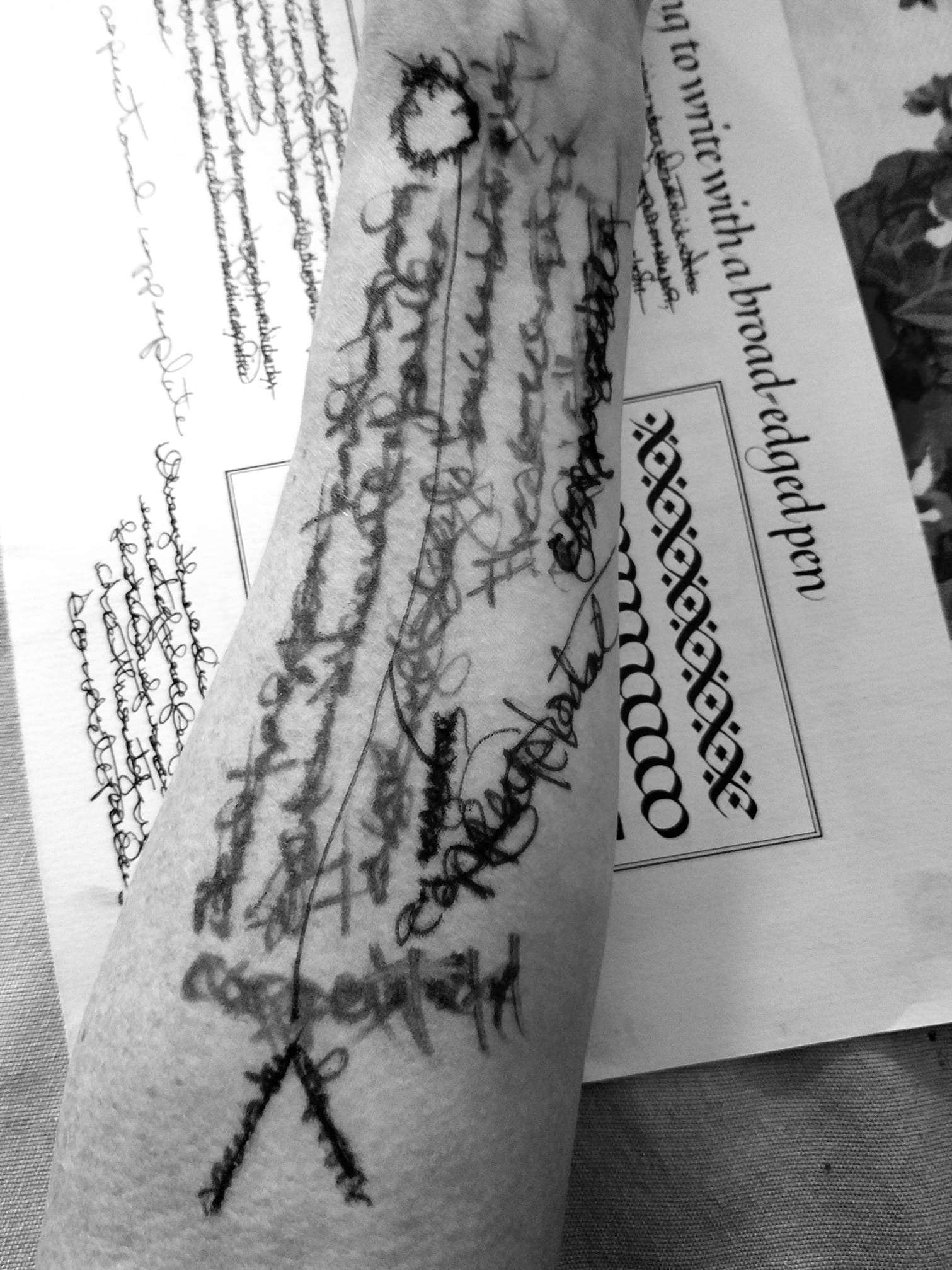
I want to fit that into the femmeglitch or femsemics somehow. I am considering the female body and its subordination or domination depending on the experience. I would like to study this art more. I use photos of the writing and glitch them, then process the grays and blacks.
What results is dark, metallic textures and tones: super- fragmented. You have likened it to Jim Leftwich’s definition of the asemic and a brooding, Scandinavian Existential philosophy. I referred to this casually somewhere as ‘Swedish death metal,’ and that is the name that is already popular on the vispo social media circuit.
When in collaboration, I never know what the final colors will be, unless they are purposely manipulated. I want it to be as organic as possible. But these, Gradients, are just filtered and adjusted purposely. I want to stick with the body as a driving force in my work. I have discussed my experiences with my body and sex before in interviews so I will not go into that here. We are supposed to be talking about WAAVe. But it is all connected.
AF2: Indeed, you have connected it all! Thank you for your time, candor and work. Special thanks for a tantalizing peak at Gradients. I hope you will join us again at the Asemic Front project.

-ssSss-


Asemic Poetica: Volume 1 by Amy Rodriguez
Asemic Poetica: Volume 1 by Amy Rodriguez. Fayetteville, Arkansas, USA. 2021. 25 plates
By De Villo Sloan
Living in the Ozark Mountains of Arkansas, USA, Amy Rodriguez is widely admired in the asemic writing community for her abstract expressionist-based paintings that, as she has written, “feature asemic writing weaving around and within pools of intense color.” This a succinct description of the pieces in her book Asemic Poetica: Volume I.
The edition showcases 25 beautiful plates brilliantly colored with sharp detail. This is a slim but visually lush collection that requires many repeat visits to fully appreciate. The collection is lacking in prose explication, and this reader is left wanting to know more about the series and the context of its creation.
Rodriquez’s book represents the successful synthesis of abstract painting and asemics, a branch of the asemic tree known for bearing fruit bitter to the taste. Rodriguez avoids these pitfalls with ease rooted in commitment to artistic discipline. While wholly individual in style, her work is in the milieu of USA vispo giants David- Baptiste Chirot, Diane Keys and Karla Van Vliet, among others.
Diane Keys goes to extreme lengths (such as cooking pages in her oven) to produce impressionistic, tie-dyed-like fields upon which she overlays images and/or symbols (the ultimate "cooked" poetry). In comparison, Amy Rodriguez integrates organic, asemic clusters and strands into larger forms, an area of great interest to contemporary asemic writers. Her work, in fact, is even more organic than many of Diane Keys’s ground-breaking compositions.
_____________________________________________
"From the perspective of 2022, [Noam Chomsky's] surface and deep structure offer a lens for understanding asemics, namely the notion that deep structure reveals an innate ability of all humans to communicate beneath and across language’s shifting surface structures."
__________________________________

Deconstructive asemics tend to produce disruption and fragmentation, while Asemic Poetica: Volume 1 clearly strives for wholeness and harmony.
Jim Leftwich’s asemic theory, which is sending so many on a quest to find the Holy Grail of “signifying nothing,” is - to me personally - a compelling model. Amy Rodriguez, with her invocation of abstract expressionism and unity, runs contrary to the Leftwichian school. She shows an affinity to the postliterate brand of asemics championed by Michael Jacobson. At this point in time, we might consider the validity of both “schools” in co-existence.
Recent posts at AF2, my own writing included, have applied critical theory and linguistics to the still-daunting task of finding the genre limits of asemic writing. Reading Asemic Poetica: Volume 1 has led me to consider another aspect of linguistics that could also contribute to asemic theory: The highly influential, beginning in mid-20th century, linguistics of Noam Chomsky.

Examples of surface structure are numerous:
You ate the green apple.
The green apple you ate.
Both sentences, one is excessively awkward, have different structures yet communicate the same idea.
Noam Chomsky’s linguistic theory has endured decades of analysis and has produced numerous interpretations. My musings here are yet another reading that uses Chomsky as a starting point for contemporary asemic theory.
From the perspective of 2022, surface and deep structure offer a lens for examining asemics, namely the notion that deep structure reveals an innate ability of all humans to communicate beneath language’s shifting surface structures.
Viewed in this way, we can see asemic writing as a new discourse moving us toward shared expression and communication beyond the limits of languages and cultures. Asemic Poetica: Volume 1 is an ideal representation of this theory and is deeply worthy of our shared attention.
-sSs-


